EN
 DE
 Paul H.Print & Material · knows every colour batch
7 minutes
Everyone's seen that faded car badge where the red has turned into a washed-out orange, while the black right next to it still looks brand new. That's not bad luck and it's not bad printing — colour pigments age at very different speeds. Knowing that helps you pick the right design and the right spot to stick it.
What UV light does to printing ink
Colour comes from pigments, and pigments are molecules with a specific structure. UV radiation carries enough energy to break chemical bonds inside that structure. Once a bond breaks, the way the pigment absorbs light changes — it gets paler. The process can't be reversed; no cleaner and no polish brings the colour back.
How fast that happens depends on the pigment type. Organic pigments — which cover most bright reds, magentas and oranges — are more sensitive than inorganic ones. Carbon black is practically indestructible.
| Colour | First change | Clearly visible | Typical behaviour |
|---|---|---|---|
| Black | after years | barely | At most turns slightly grey |
| Blue | approx. 3 years | from 5 years | Loses depth, but stays blue |
| Green | approx. 2–3 years | from 4 years | The yellow component goes first |
| Orange | approx. 1.5 years | from 3 years | Gets paler and lighter |
| Red / Magenta | approx. 1 year | from 2 years | Tips towards pink |
These figures apply to permanent outdoor mounting in Central Europe on a south-facing surface. Indoors and in the shade, multiply them several times over.
Compass direction matters more than the season
A south-facing surface gets roughly double the UV dose of a north-facing one, averaged over the year. Horizontal surfaces — a car bonnet, a campervan roof, the lid of a toolbox — get even more, because they catch the midday sun at the steepest angle. If you have a choice, stick to the side, not the top.

What this means for choosing a design
For permanent outdoor use, designs hold up better when their impact doesn't rely on a single bright colour:
- Good: black on white, thick outlines, high contrast — stays readable even once saturation drops
- Medium: two-colour designs with a dark outline
- Risky: fine gradients and pastel tones — any change shows immediately
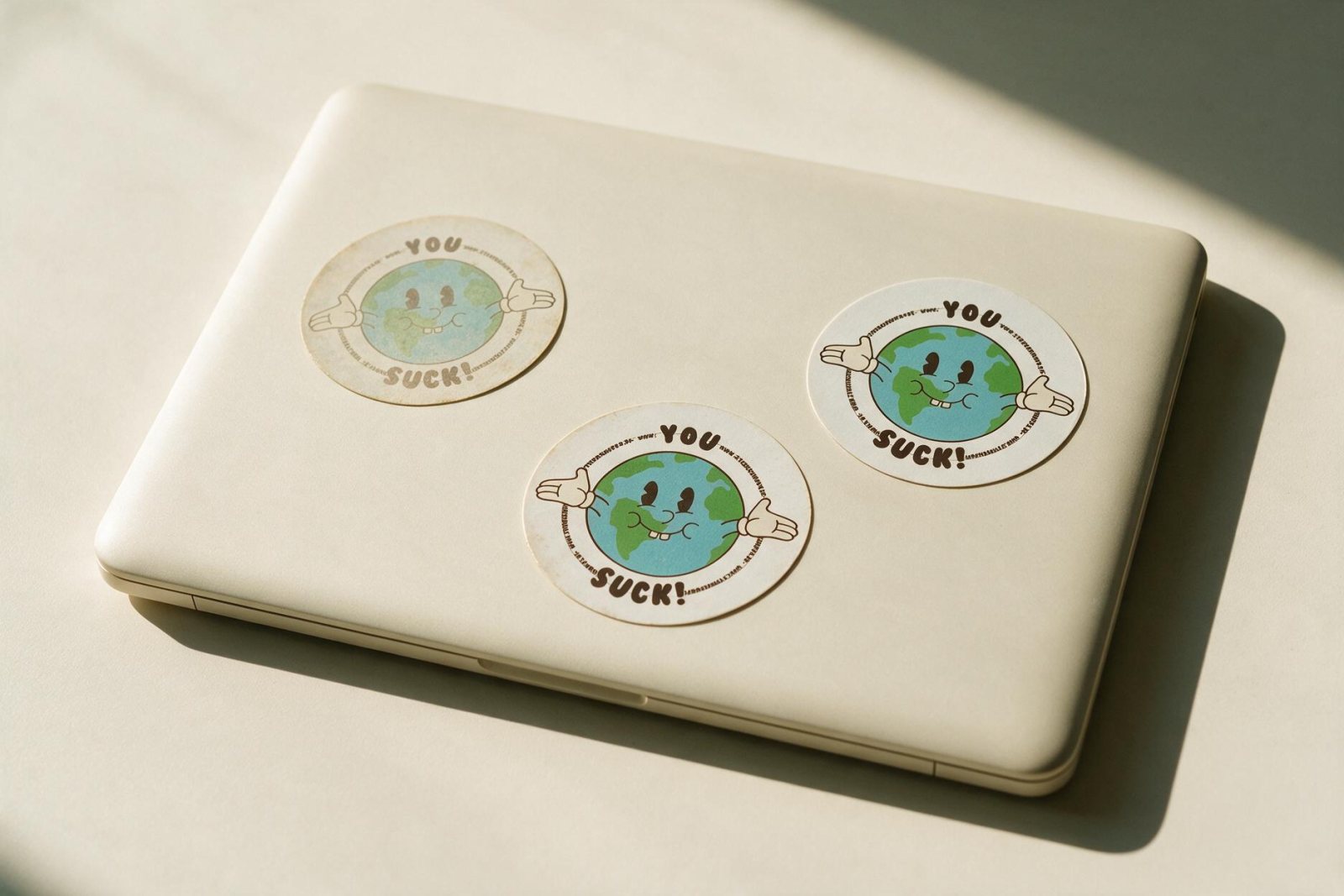
That's why text-based designs work so well outdoors. A slogan stays a slogan, even if it's two shades lighter after three years. You'll find exactly that in our joke stickers, and for the rear windscreen in the car stickers.
Indoors, a sticker lasts until you stop liking it. Outdoors, it lasts until the sun stops liking it.