EN
 DE
 Jana R.Customer Service
5 minutes
Water bottles get more complaints than any other surface — and it's almost never the sticker's fault. It's that four problems stack up at once here: a curved surface, an often powder-coated or painted finish, constant hand contact, and in a lot of households, the dishwasher.
Why round is harder
Vinyl is stretchy, but only really well in one direction. Wrap a wide sticker around a bottle and the middle of the film has to travel further than the edges — it can't, so wrinkles form at the sides. The smaller the bottle and the wider the sticker, the stronger the effect.
Rule of thumb: the sticker shouldn't be wider than a third of the circumference.
On a typical 0.5-litre bottle with a 7 cm diameter, that's roughly 22 cm of circumference — so about 7 cm of sticker width, max. Our designs measure 7.4 cm on the longest edge. Round and square designs fit comfortably; a landscape one sits right at the upper limit with its long edge. It works, but only looks calm if you stick it offset rather than dead centre on the front.
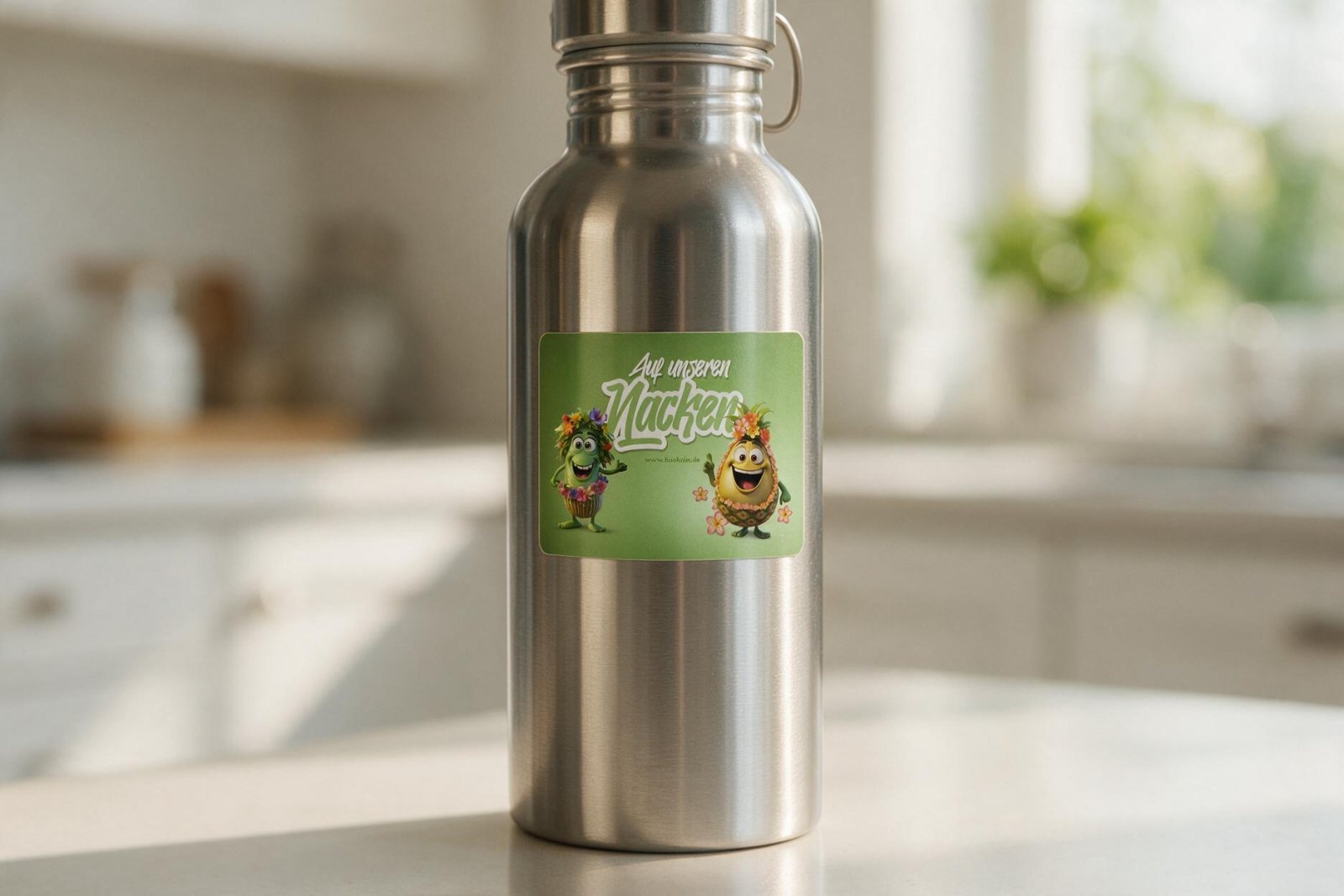
The grip zone
Everyone grabs a bottle in the same spot: the middle, opposite the lid hinge or the drinking spout. That's exactly where palm and fingers rub across the sticker several times a day, plus skin oil and sunscreen in summer.
So stick the design deliberately offset — higher, lower, or on the opposite side. It looks just as good and lasts twice as long.
The surface
- Bare stainless steel: Perfect. Degrease, stick, done.
- Powder-coated: Very good, the slightly rough texture gives the adhesive something to grip. Degrease new bottles first, since release-agent residue is often still there.
- Painted with a soft-touch finish: Tricky. The adhesive bonds to the soft coating, not the metal underneath — the coating can come off with the sticker when you peel it.
- Tritan / plastic: Good, but plastic moves more than metal with temperature swings. Check the edges more often.
- Glass with a silicone sleeve: Yes on the glass, no on the silicone. Silicone won't take adhesive — that's a physics problem, not a technique one.
For the bottle that goes outside every day, the outdoor designs are the best fit — they're built for rain and sun. For the bottle in a school bag, the school stickers come in smaller sizes.